
Baby spoon and fork sets fail sourcing reviews for three reasons: a tip that is either too stiff for gums or too floppy to actually scoop, tines that snap or pass small-parts testing by luck, and a two-material joint where the silicone handle separates from the steel or plastic core after a few dishwasher runs. This guide walks through choosing utensils by feeding stage, the construction details worth inspecting on a sample, and the tests that separate good batches from the ones that generate returns.
Utensils are the product category where I see first-time buyers overpay for features nobody uses, and experienced buyers under-spec the two details that matter. We mold silicone utensil components at QLink Silicone alongside our bib and bowl lines, and I’ve reviewed enough failed competitor samples to know exactly where they go wrong. Here’s the honest version of what to check before you place an order.
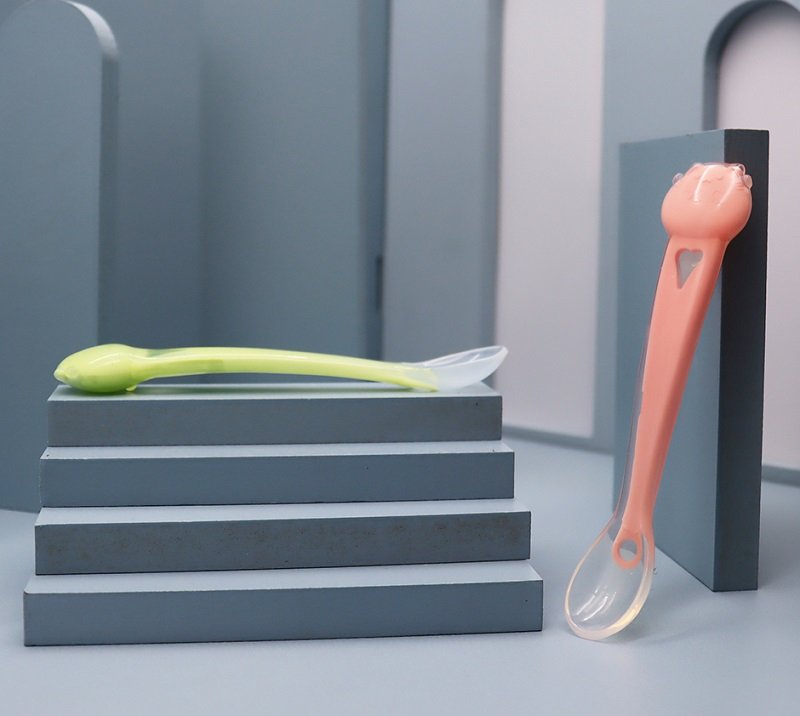
Match the utensil to the feeding stage
The single most common listing mistake is selling one spoon as suitable for everything from 4 months to 3 years. Gums, grip strength, and food texture change too much across that span. Three stages cover it:
| Stage | Age | Right tool | What the tip must do |
|---|---|---|---|
| Parent-led first tastes | 4-6 months | Soft silicone-tip spoon, shallow bowl | Give under pressure; a gum press should flatten it without resistance |
| Self-feeding practice | 6-18 months | One-piece silicone spoon, chunky handle | Firm enough to scoop purees, soft enough on face-strikes |
| Real meals | 12 months+ | Steel head with silicone handle, fork joins in | Actually cut pasta and spear fruit; tines do real work now |
Selling a set per stage also doubles your listing count from one SKU family. The stage story gives retail packaging something honest to say, which matters more than another cartoon character on the handle.
Tip stiffness is the spec nobody writes down
Ask three factories for a “soft tip spoon” and you’ll get three different hardnesses. Silicone Shore hardness for utensil tips typically runs from around 30A, soft enough to deform against gums, up to 50A, which holds a scoop shape but pushes back. Neither is wrong; they’re different products. The mistake is not specifying which one you’re buying, then discovering your “gentle first spoon” has a tip firm enough to poke.
The ten-second sample test: press the tip against your own inner wrist. A first-stage spoon tip should visibly flatten and spring back. A self-feeding spoon should bend without folding over. If the supplier can’t tell you the shore hardness of the tip material, that’s the answer in itself.
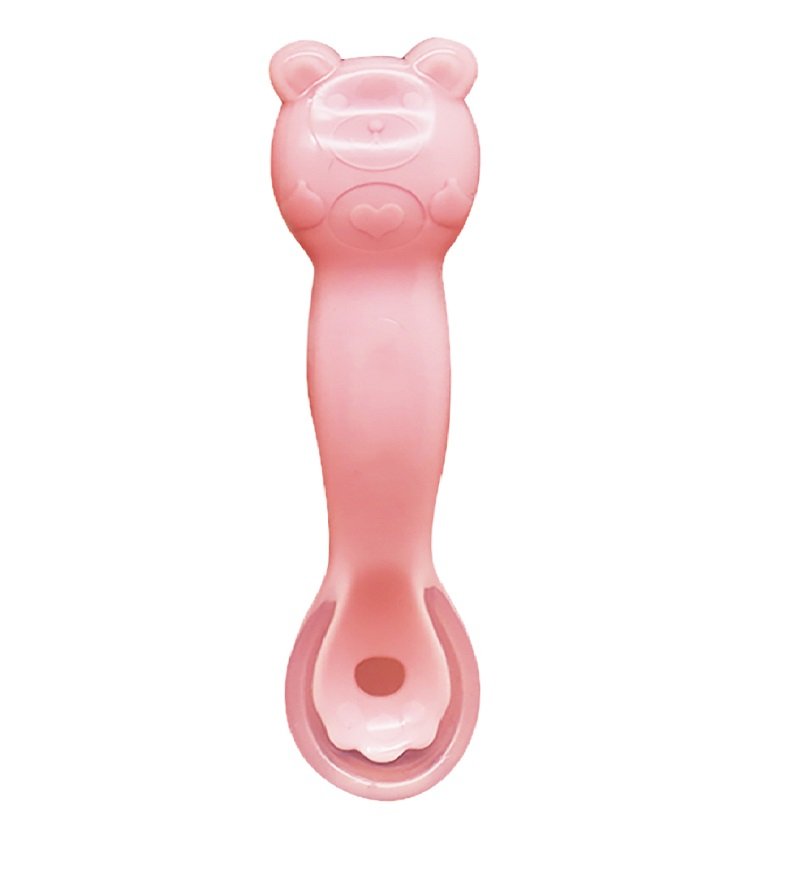
One-piece versus two-material construction
Full-silicone spoons are molded in one piece. There’s nothing to come apart, they boil clean, and tooling is straightforward. The trade-off is that pure silicone tines and scoop edges underperform on real food; silicone forks are honest training tools and useless steak forks.
Two-material utensils pair a steel or hard-plastic working head with an overmolded silicone handle. This is where the quality gap between factories opens wide. The silicone has to bond chemically to the substrate during overmolding; done right, you cannot peel it off with a fingernail. Done cheaply, with the wrong primer or no surface preparation, the handle twists loose within weeks. On any sample with an overmolded grip, grip the silicone and try to rotate it against the core. Then boil the sample, dry it, and try again. If it loosens after one boil, the production units will not survive a month of dishwashers.
The lion-shaped sets we produce, with a steel spoon and fork head overmolded into a chunky silicone grip, follow this exact discipline; the grip passes the twist-and-boil test before any batch ships.
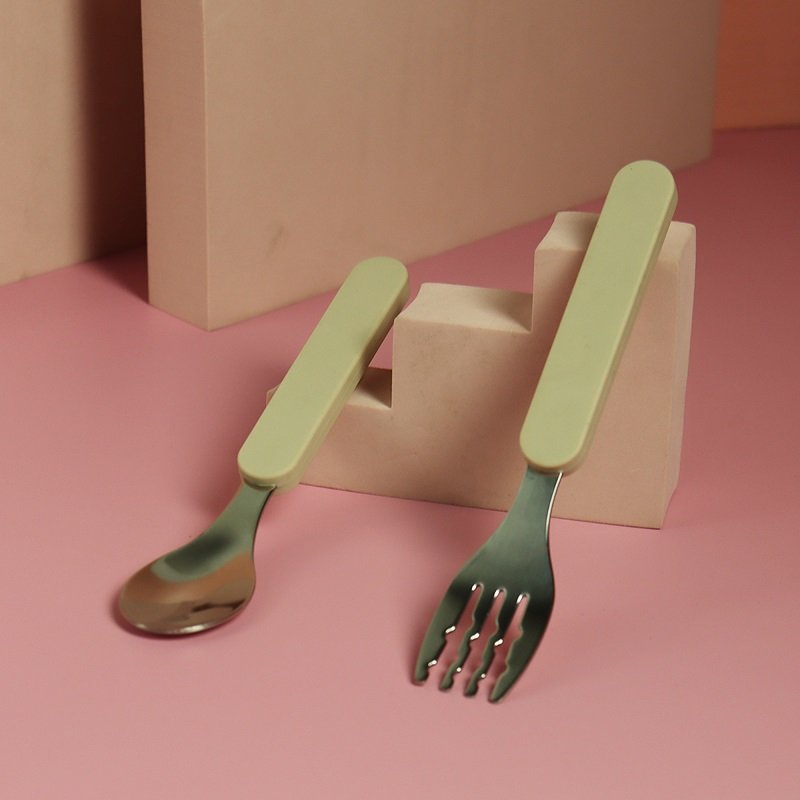
Fork tines: the detail that gets recalled
Fork tines sit at the intersection of two requirements: sharp enough to pick up food, blunt enough to pass safety testing for an item a toddler will absolutely point at their own eye. EN 14372, the European standard for cutlery and feeding utensils, sets the requirements here, and it’s the test protocol worth asking your supplier about by name.
What we check on every tine batch: pull test on each tine (they must not detach or deform permanently under load), tip radius check against the standard, and a fatigue bend test, since repeated stabbing into dinner eventually works a weak tine loose. A steel tine riveted or overmolded into place outperforms glued plastic-core tines every time; if a quote describes glued construction, ask what happens after 50 dishwasher cycles and watch how confidently they answer.
QC checks specific to utensils
Thin, hand-held products have their own failure modes. Our utensil QC plan covers:
Tip tear test. Stretch the silicone tip deliberately. Filled or poorly cured silicone tears with a ragged edge; good material deforms and recovers. A tip that tears during a gum-press session becomes a choking fragment, so this test is not optional.
Handle flex and return. Bend the handle 90 degrees and release. It should return with no white stress marks at the transition to the head. Stress marks at the neck are where handles snap off in real use.
Overmold bond. The twist-and-boil test described above. Document it in your QC plan with a number: how many degrees of rotation, at what torque, after how many boil cycles.
Dishwasher and boil cycle. One boiled sample, one dishwashered sample, then repeat tip, bond, and flex checks. Platinum-cured silicone handles -40°C to 230°C, but the bond lines have to earn that rating, not assume it.
Compliance for utensils
Utensils are food-contact baby products, and the standards are specific: for the US, FDA-registered manufacturing (our facility is No. 3023263259), silicone compliance with 21 CFR 177.2600, and CPSIA testing. For Europe, LFGB migration testing plus EN 14372, which covers cutlery-specific mechanical requirements including the tine and edge checks above. Steel heads add a nickel-release consideration for the EU market, which your supplier should document for the grade of steel used. The market-by-market breakdown lives in our certification comparison.
Customization and order reality
Utensils are friendly to first orders: the parts are small, tooling for a spoon or fork runs modest, and color is free branding since platinum-cured silicone matches any Pantone shade. Two-material designs cost more in tooling and need a longer sample round, because the bonding parameters are the actual product. Our OEM orders start at 500 pieces, catalog designs at 1,000, standard lead times run 30 days for standard orders and 45 days for full custom work. The stage-by-stage process is in our design-to-shipment walkthrough.
Utensils pair naturally with the rest of a feeding line: our silicone bib guide, the suction bowl line, and the silicone fruit feeder pouch all share the same certified material family, which keeps a product collection coherent in photos and consolidated in one container. For the supplier-level vetting before any of that, our factory audit checklist walks through what to verify, and the project team can send stage-matched sample sets so you can feel the tip hardness difference yourself before committing.
Frequently asked questions
What age should a baby start using a spoon and fork?
Parent-led soft-tip spoons start around 4-6 months. Self-feeding one-piece spoons suit 6-18 months. Steel-headed fork and spoon sets work from about 12 months, when real cutting and spearing begin.
Are silicone spoon tips safe for gums?
Yes, when the tip hardness is specified for the stage: soft enough to flatten under a gum press for first-stage spoons, firmer for self-feeding. Unspecified “soft” tips are the main thing to test on a sample.
Silicone or stainless steel baby utensils: which is better?
They solve different stages. All-silicone suits gum-heavy first months; steel heads with silicone handles perform better from about 12 months when food actually needs cutting. The overmold bond, not the material choice, is where quality fails.
What MOQ applies to custom baby utensils?
OEM custom utensils start at 500 pieces, catalog designs at 1,000. Two-material designs need a longer sampling round because the bonding process is the product. Quotes far below these numbers usually mean shared molds or a trader.
Ready for the 12 months+ stage? See our dedicated guide to the dual-material baby fork and spoon set — silicone grips overmolded on 304 stainless steel tips.