
Most silicone bib complaints trace back to three design decisions made before production even starts: a shallow or floppy pocket that dumps food instead of catching it, a neck closure that either scratches or gives up after a few weeks, and a printed graphic that fades in the dishwasher. This guide covers how to judge all three on a sample, what sizes fit which ages, and what custom bib production actually costs a brand.
I’ve run bib projects at QLink Silicone since our bib line launched, and the same sample-review conversation happens over and over: a buyer compares two quotes, picks the cheaper one, and six months later asks us to fix peeling prints on their second order. The expensive lesson was avoidable at the sampling stage. Here’s what we check on our own line, and what I’d want any buyer to check on ours.
The pocket is the product
Parents buy a silicone bib for one job above all others: catching food before it hits the floor. Two details decide whether the pocket does that job.
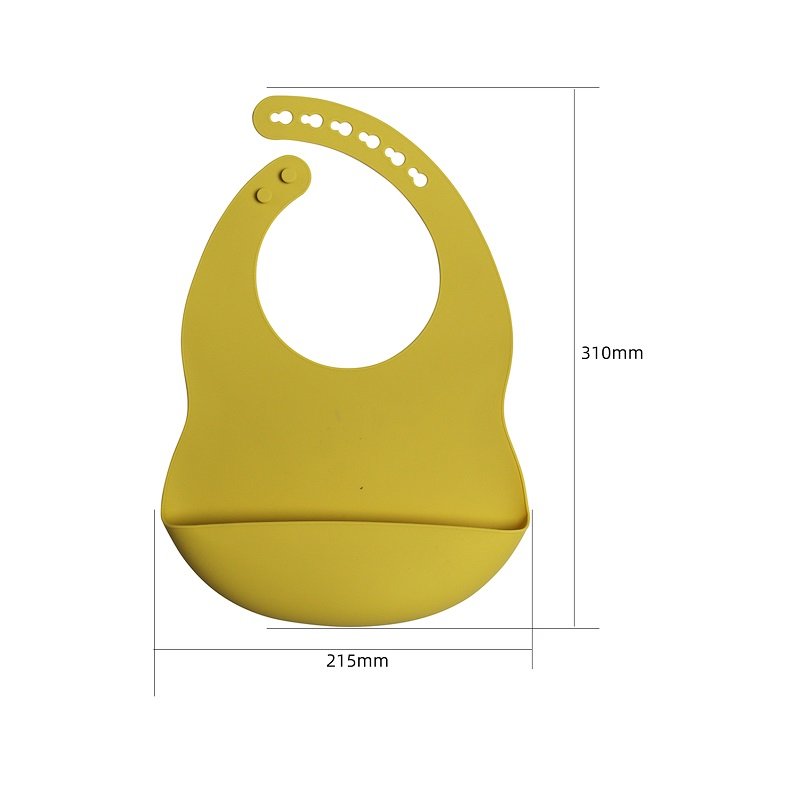
Pocket depth and fold line. A deep pocket (roughly 30 mm and up when flexed outward) holds cereal, banana slices, and the constant stream of dropped pasta. The fold between the flat bib face and the pocket has to be molded in, not glued or welded. Glued pockets survive the showroom and fail in the dishwasher; the adhesive line yellows first, then peels. On a sample, flex the pocket open and closed twenty times, then look at the fold under good light. Any whitening stress marks there will become cracks within a few months of real use.
Pocket shape when seated. Some pockets look great flat on a spec sheet and collapse flat against the bib when the baby leans forward, spilling everything they caught. Ask for a photo or video of the bib worn by an actual child, seated. This costs the factory nothing to provide, and reluctance to show it tells you something.
Neck closures: what we make and what we avoid
The closure choice drives both safety testing and parent experience more than any other component:
| Closure type | What we use it for | Watch points for buyers |
|---|---|---|
| 4-6 position snap buttons | Standard pocket bibs, 6 months to 3 years | Buttons must pass pull and small-parts tests; check every position snaps positively |
| Hook-and-loop (velcro-style) | Cloth-silicone hybrid bibs | Hook side collects lint and degrades in the wash; silicone-only designs avoid it for good reason |
| Simple teardrop neck | Smallest first-foods bibs | No fastener at all, but sizing must be generous; check neck circumference against your market’s age claims |
One warning from our QC records: neck buttons are the one bib component we’ve had suppliers substitute quietly. The buttons arrive looking identical but crack at the base during pull testing. If your contract specifies a button supplier or material, inspect the first production run against the golden sample, not just against photos.
Sizing: two formats cover most of the market
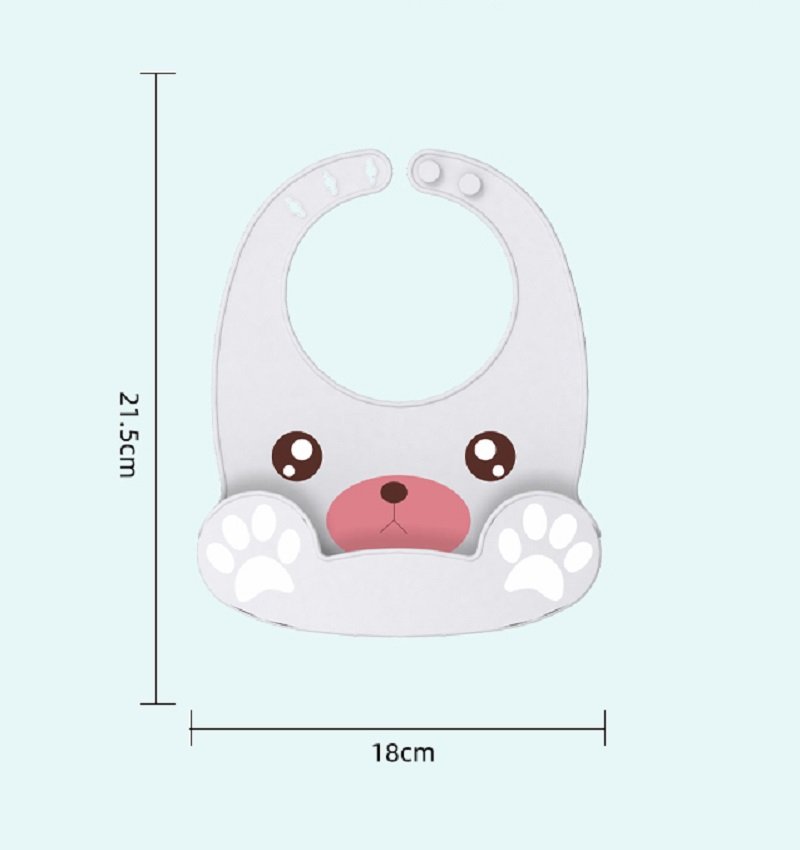
Most brands only need two SKUs here. A standard bib at roughly 215 x 310 mm covers 6 months to 3 years with the adjustable neck. A compact version around 180 x 215 mm suits 4-9 months, when meals are short and mess is mostly milk and puree. Beyond that, long-sleeve bibs exist for the pasta-throwing stage, but they blend silicone with fabric sleeves, which adds a different supplier risk and a seam worth testing in the wash. We stock the two standard formats and can quote the hybrid style, but I’d steer a first order toward the simple versions; they’re where the margin and the repeat purchases are.
Prints and logos: where cheap bibs fail
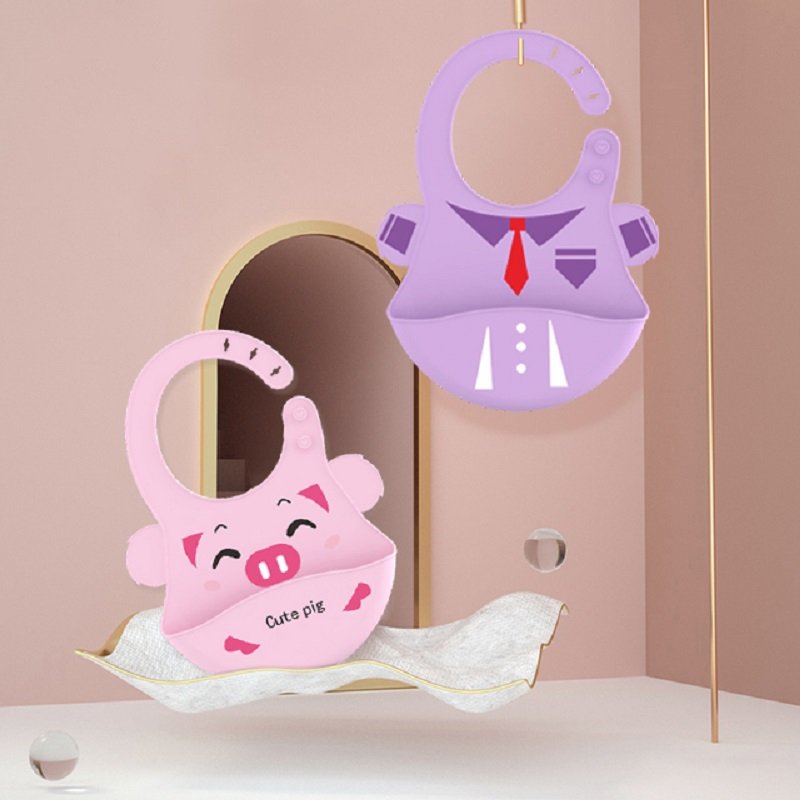
Graphics on silicone come in three routes, and buyers should know which one they’re getting. Pad printing is the cheapest and the first to fade; it sits on the surface and wears under scrubbing. Silk-screen printing with silicone ink bonds chemically and survives dishwashers, but the ink must be food-contact certified for your market, which the factory should document, not just claim. Debossing and embossing are molded into the silicone itself and cannot wear off; they cost more in tooling and nothing per unit after that.
The test worth demanding: run a printed sample through ten dishwasher cycles, then rub the graphic firmly with a thumb. Surface prints haze. Proper silicone-ink prints and molded deboss look the same as day one. We run this exact cycle on every printed bib batch before packing, because a faded cartoon face is the fastest way a bib collects a one-star review.
QC checks specific to bibs
Bibs are thin-walled, which changes the risk profile compared with bowls or teethers:
Neck pull test. Grip the neck band and the bib body, pull firmly in opposite directions. The closure and the thin neck sections must hold without tearing. Run it on several samples, because thin-wall parts vary more than thick ones.
Edge and hole inspection. The neck opening and every button hole is a die-cut or punched edge. Run a finger around them. A rough punched edge chafes a baby’s neck, and this is the complaint we see most often from bibs bought on price alone.
Thickness consistency. Bib walls run around 1.0 to 1.5 mm. Below that, the bib flops and the pocket won’t hold shape; above it, the bib sits stiff against the chest. A vernier check at three points on the sample takes a minute and catches filler-heavy material too.
Wash cycle. One boiled sample, one dishwashered sample, then repeat the flex and print checks. Platinum-cured silicone handles -40°C to 230°C, but the print and the fold line have to survive the same treatment.
Compliance and documentation
Bibs count as food-contact baby products on both sides of the ocean. For the US: FDA-registered manufacturing (our facility is No. 3023263259), silicone compliance with 21 CFR 177.2600, and CPSIA testing including lead and phthalates. For Europe: LFGB migration testing, which is stricter than FDA on volatility and carries more weight with EU distributors. Printed designs add the ink itself to the compliance scope, so ask for the ink’s food-contact certificate separately from the silicone’s. Our certification comparison breaks down which markets need which documents.
What custom bib production looks like
Bibs are among the friendliest products for a first-time brand: tooling is modest because the part is flat, color matching runs to any Pantone shade, and branding options span debossed logos, printed graphics, and full retail packaging with your own inserts. Our OEM orders start at 500 pieces and catalog designs at 1,000, with standard lead times of 30 days for standard orders and 45 days for full custom work including new tooling. The stage-by-stage process, from drawing to shipment, is in our design-to-shipment walkthrough.
Bibs also pair naturally with the rest of a feeding line. Buyers frequently combine them with our bibs and kitchen tools range, the suction bowl line, or the newer silicone fruit feeder pouch, all molded from the same certified material family, which keeps your packaging story and your shipment consolidated.
How to judge a bib sample in ten minutes
Flex the pocket twenty times and inspect the fold. Snap every neck button position and pull-test the band. Run a finger around every cut edge. Check wall thickness at three points. Boil one sample and dishwasher another, then repeat the flex and print checks. A factory’s sample tells you what its production will be; if the sample fold already shows stress whitening, the retail version will be worse. If you want a second opinion, our factory audit checklist covers supplier-level vetting, and the project team can send a graded sample set so you can compare closure and print options physically before committing.
Frequently asked questions
What age are silicone bibs for?
Standard 215 x 310 mm pocket bibs fit roughly 6 months to 3 years with an adjustable neck. The compact 180 x 215 mm format suits 4-9 months. Long-sleeve styles cover the toddler throwing stage.
Are silicone bibs dishwasher safe?
One-piece platinum-cured bibs with molded or silicone-ink prints are. Pad-printed graphics fade under repeated dishwashing, so confirm the print method before ordering.
Silicone bib vs plastic bib: is it worth the higher price?
Silicone survives boiling, dishwashers, and toddler abuse without cracking or staining the way plastic does, and it rolls up for travel. Retail margins support the difference; repeat-purchase and review data favor it too.
What MOQ applies to custom printed bibs?
OEM custom bibs start at 500 pieces, catalog designs at 1,000. Significantly lower “custom” quotes usually mean shared tooling or a trading middleman, both of which limit your control over print quality and material.