
Around 12 months, parents hit the same wall: the all-silicone training spoon that worked at 8 months now bends when the toddler stabs spaghetti, and the all-steel fork from the family drawer is too hard on tender gums. The fix is not choosing between the two materials — it is using each where it wins. This guide explains how a baby fork and spoon set with a silicone handle and a stainless steel tip works, what to check before ordering one, and why the same grip skills babies build on teethers carry straight into self-feeding.
Our factory produces this category as a dual-material build: food-grade silicone overmolded around a 304 stainless steel core, in themed shapes like the elephant set below. Same silicone platform as our teether line, same color program, one shipment.
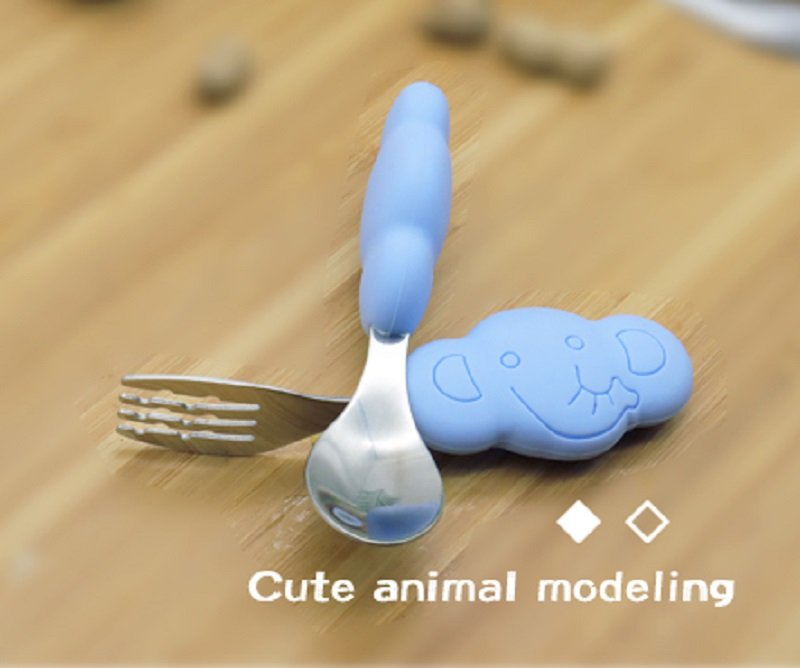
Why the two materials share one job
A dual-material set is not a marketing combo — each material solves a specific failure of the single-material versions:
| Component | What it does | Failure it prevents |
|---|---|---|
| 304 stainless steel tip | Pierces, cuts and scoops real food without flexing; food-safe grade, dishwasher-proof | The bent-spoon problem: all-silicone tips flex so much toddlers push food off the plate |
| Silicone handle grip | Warm to hold, non-slip when wet, gentle on gums if the toddler chews the handle mid-meal | The cold-metal problem: bare steel grips slip in greasy hands and feel harsh in the mouth |
| Overmolded bond | Silicone is molded onto the steel, no glue joint | The glued-handle problem: two-piece sets that separate after sterilizing |
The transition logic for parents: steel tip does the work on the plate, silicone handles the part that meets the hand — and occasionally the teeth.
What to check before ordering a dual-material set
For importers and brands, the quote sheet hides the details that decide returns and reviews. These are the five checks we run on this category:
| Check | What to specify in writing |
|---|---|
| Steel grade | 304 (18/8) stainless for the tip — food-contact grade, resists pitting after months of dishwashing; lower grades corrode and stain |
| Bond method | Overmolding (steel inserted into the silicone mold), not adhesive assembly — ask how the two materials meet |
| Grip size | Handle diameter sized for 12-24 month fists, with texture or shape (ears, cheeks) that blocks finger slip |
| Tine & edge design | Fork tines rounded and short; spoon depth shallow enough for a toddler scoop without overload |
| Temperature spec | Silicone rated -40°C to 200°C covers freezer, boiling water, steam sterilizers and dishwashers |
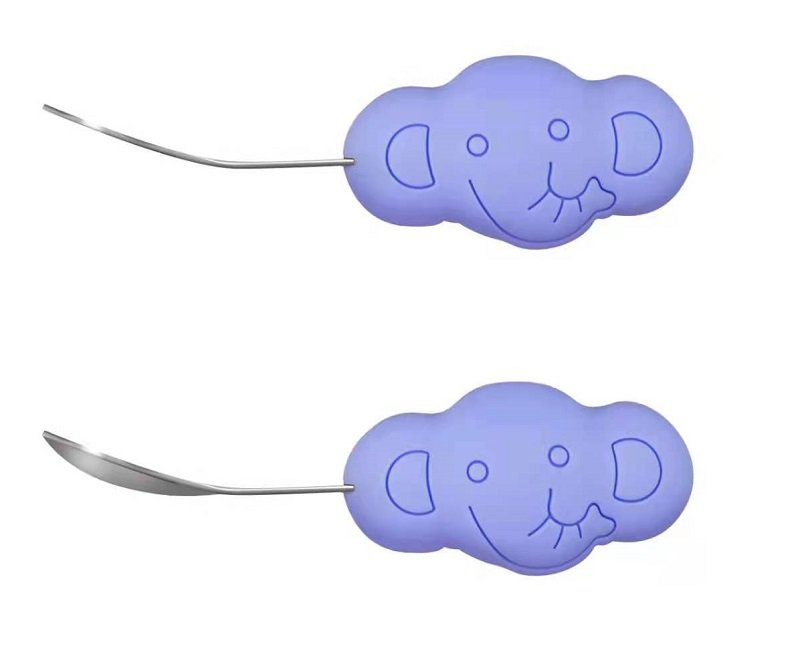
The elephant grip: why themed handles sell
Function gets a set onto the shortlist; theme gets it into the cart. The elephant handle works commercially for three reasons: the animal face photographs well for retail listings, the molded ears and trunk give small fingers natural grip points, and the theme extends across a range — our catalog runs the same dual-material build in lion and pig versions, so a brand can launch a matching animal family instead of a single SKU. Faces and details are molded in, which keeps the set safe in the mouth and safe in the dishwasher.
From teether to utensil: the grip skills are the same
There is a reason the silicone grip feels instantly familiar to a one-year-old: the hand skills were already built on the teether. Months of palming and rotating a chunky silicone teether train exactly the wrist rotation and pinch-to-palm transition a fork grip needs. For brands building a category story, this is the merchandising bridge:
- Shapes and textures — the textured surfaces babies explore on teethers are the same surfaces that make a utensil grip non-slip. Our teether guide covers how teether shapes and textures develop these skills.
- Safety checks transfer — the one-piece molding logic and no-small-parts rules we apply to teethers apply to the silicone half of a fork and spoon set. The teether safety checklist is a good pre-order read for any silicone-grip product.
- One factory, one platform — teethers and utensil grips run on the same LSR molding lines with the same color program, which is why brands usually extend from a teether line into feeding. The teether manufacturing walkthrough shows the shared process.
If your catalog starts at teethers, the dual-material utensil set is the natural second act — same buyer, same material trust, next developmental stage.
Safety and care notes for the set
- Material spec — food-grade silicone (BPA-free) over 304 stainless steel; nothing in the food-contact path except those two materials.
- Temperature range — -40°C to 200°C: freezer-safe, boiling-water and steam sterilizer safe, dishwasher safe.
- Cleaning — one-piece overmolded handle means no seam to trap food; the steel tip tolerates daily dishwashing without staining.
- Age fit — designed for the 12 months+ self-feeding stage, after all-silicone training spoons; pair with a training spoon for the 6-12 month shelf position.
FAQ — Baby fork and spoon sets with silicone grips
1. When should a toddler switch from a silicone-tip spoon to a stainless steel tip?
Typically around 12 months, once the child stabs and scoops with intent. All-silicone tips flex, which is safe for gum-first beginners but frustrating once real cutting is needed. The dual-material set covers the transition without buying two stages.
2. Is the stainless steel tip safe for babies’ mouths?
Yes — the tip is rounded, and food-contact uses 304 food-grade steel. The silicone handle, not the steel, is what the toddler mostly holds or chews; the steel does its work on the plate.
3. Can the silicone handle come off the steel core?
Not in a properly made set: the silicone is overmolded directly onto the steel insert, with no glue joint to fail. This is one of the five checks to specify when ordering — ask how the bond is made.
4. Can we customize the animal theme and colors?
Yes. Colors are Pantone-matched, and themed grips (elephant, lion, pig and beyond) run on the same dual-material build. Existing tooling keeps custom color programs at catalog pricing; a new animal shape requires new tooling for the grip.
The silicone materials guide covers the LSR grades used across both categories, and our full baby utensils buying guide maps every spoon and fork stage. Ready to add a dual-material set to your line? Send an inquiry for samples and Pantone options.