Private Label Silicone Baby Products: A Complete Guide for Brands and Importers
Launching a baby product brand does not always require developing every product from scratch.
For startups, importers, online sellers, and established retailers, private label silicone baby products offer a practical way to build a branded product line using existing manufacturer designs and customized packaging.
Instead of investing immediately in entirely new product designs and molds, you can select suitable products, customize available features, add your brand identity, and prepare the products for your target market.
But how does private-label silicone baby product manufacturing work? What can you customize? What is the typical MOQ? And how should you choose a reliable manufacturer?
This guide explains the process step by step.
Quick Answer: What Are Private Label Silicone Baby Products?
Private label silicone baby products are products manufactured by a supplier and sold under a retailer’s or brand owner’s name.
The brand typically selects an existing product design and customizes available branding elements, such as colors, packaging, labels, or other features offered by the manufacturer.
Common private-label silicone baby products include:
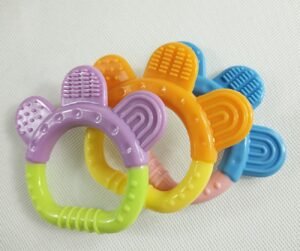
- Silicone baby teethers
- Silicone baby plates and bowls
- Silicone bibs
- Baby spoons and forks
- Silicone feeding sets
- Pacifiers and selected bottle accessories
- Silicone cups and mats
Private labeling can reduce the need for original product development, but customization options, MOQ, testing responsibilities, and intellectual property terms vary by product and supplier.
In simple terms: the manufacturer makes the product, while your business builds the brand, positioning, packaging, and customer experience.
1. Why Choose Private Label Silicone Baby Products?
Private labeling can be useful if you want to enter the baby-products market without developing a completely new product range.
Lower Initial Development Investment
Using an existing mold may help you avoid the cost of developing a new mold, provided the product meets your requirements and the manufacturer is authorized to use the tooling for your order.
Your initial investment may instead focus on samples, product orders, branding, packaging, and market launch.
Faster Product Launch
An existing product design may reduce the time needed for engineering and tooling.
You still need to allow time for sample approval, any necessary testing, packaging preparation, production, and shipping.
Easier Product-Line Planning
You can select several complementary products to create a coordinated collection.
For example, a baby feeding collection might include a suction plate, bowl, bib, spoon, and cup.
Whether these products can be ordered together depends on the manufacturer’s product range, MOQ, and production requirements.
More Focus on Branding and Marketing
Private labeling allows your business to focus on:
- Brand identity
- Product positioning
- Packaging design
- Product photography
- Retail distribution
- E-commerce listings
- Customer service
The manufacturer supports the production side, while your business develops the market-facing brand.
2. Which Silicone Baby Products Can You Private Label?
The available options depend on the manufacturer’s existing product range.
Silicone Baby Teethers
<text color=”secondary” size=”sm”>Common customization options</text>
- Available colors
- Packaging
- Product cards or labels
- Selected branding options
If you want a new shape, texture, or molded logo that is not supported by the existing mold, additional tooling may be required.
Silicone Baby Plates and Bowls
<text color=”secondary” size=”sm”>Common customization options</text>
- Color selection
- Product combinations
- Packaging
- Branding on packaging
- Selected molded logo options, where available
These products can be suitable for brands building a feeding collection.
Silicone Baby Bibs
<text color=”secondary” size=”sm”>Common customization options</text>
- Color
- Packaging
- Product combinations
- Available design options
Custom dimensions, pocket structures, or fastening details may require a separate design review.
Silicone Baby Spoons and Forks
<text color=”secondary” size=”sm”>Common customization options</text>
- Available colors
- Packaging
- Sets with other feeding products
For utensils, material specifications, intended age, design, and applicable product requirements should be evaluated for the finished product.
Silicone Feeding Sets
A feeding set can combine selected products into one branded offer.
For example:
- Suction plate
- Silicone bowl
- Spoon
- Bib
- Cup
The final combination depends on the products available, order quantities, packaging dimensions, and the manufacturer’s production policy.
Pacifiers and Bottle Accessories
Some manufacturers offer existing pacifier or bottle-accessory designs for private-label projects.
These products require particular attention to their intended function, product-specific safety requirements, applicable regulations, and testing. Do not assume that compliance documentation for one product automatically applies to another.
3. What Can You Customize for a Private Label Order?
One of the most important questions to ask a manufacturer is:
What can I customize without developing a new mold?
The answer affects your initial investment and launch timeline.
Product Color
Color customization is often one of the simplest ways to create a consistent brand identity.
You can discuss:
- Available standard colors
- Custom color matching
- Number of colors per order
- Minimum quantities for each color
- Color consistency across different products
Custom colors may involve additional requirements or costs, depending on the manufacturer’s process and order quantity.
Logo and Branding
There are several ways to add branding to silicone baby products.
Packaging logo: Your logo is printed on a sticker, card, box, or other packaging element.
Molded silicone logo: Your logo is integrated into the silicone product through the mold.
Surface printing: Printing may be possible for certain products, depending on the surface, process, and durability requirements.
For existing molds, packaging branding is often the simplest starting point. A molded logo may require tooling modification or a new mold if the existing tooling does not accommodate it.
Packaging
Packaging options may include:
- OPP or PE bags
- Printed stickers
- Paper cards
- Custom printed boxes
- Retail packaging
- Customized product sets
Your packaging should match your sales channel, brand positioning, budget, and destination-market requirements.
For a small pilot order, simple packaging may be more practical than investing in fully customized retail boxes immediately.
Product Combinations
You may be able to combine different existing products into a branded collection.
For example, a brand could create a feeding starter set using a plate, bowl, spoon, and bib.
Before placing an order, confirm whether different products can be combined in one purchase order and whether each product has its own MOQ.
4. Private Label vs OEM vs ODM: Which Is Right for You?
These manufacturing models overlap, but they usually serve different needs.
| Factor | Private Label | ODM | OEM |
|---|---|---|---|
| Starting point | Existing product | Existing or manufacturer-developed design | Buyer-defined design or specifications |
| Product development | Usually limited | Depends on project | Often more extensive |
| Customization | Often limited | Moderate to extensive | Extensive, subject to feasibility |
| New mold | Usually not needed | Depends on design changes | May be required |
| Initial investment | Often lower | Varies | Often higher for new tooling |
| Product differentiation | Usually limited | Depends on customization | Potentially high |
| Typical goal | Launch a branded product | Develop a product with manufacturer support | Manufacture a specific product design |
These are common commercial distinctions, not universal legal definitions. Ask each manufacturer to explain exactly what is included in its private-label, OEM, and ODM services.
When Private Label Makes Sense
Choose private label if you want to:
- Launch a product quickly
- Test a market before investing in custom molds
- Start with existing designs
- Focus on branding and distribution
- Reduce initial product-development complexity
When OEM or ODM May Be Better
Consider OEM or ODM if you need:
- A unique product shape
- New functional features
- Custom dimensions
- A proprietary design
- More extensive engineering support
- Greater product differentiation
You can also start with private-label products and develop custom OEM products after validating market demand.
5. What Is the MOQ for Private Label Silicone Baby Products?
MOQ means minimum order quantity.
There is no universal MOQ for private-label silicone products. It depends on the product, manufacturer, order configuration, packaging, and production requirements.
Some products may have lower MOQs because the manufacturer already has the mold. Other products may require higher quantities because of production setup, material preparation, color customization, or packaging.
Before requesting a quotation, clarify:
- MOQ per product
- MOQ per color
- Whether mixed products are allowed
- Whether different colors can be combined
- Whether packaging has a separate MOQ
- Whether samples are available before ordering
Can You Start with a Small Pilot Order?
Possibly, depending on the manufacturer’s policy and the products selected.
If you are testing a new market, explain that clearly to the manufacturer.
Ask whether you can start with:
- Existing-mold products
- A limited color selection
- Standard packaging
- A small product collection
- A pilot order before expanding
A focused initial range can help you evaluate demand without committing to a large number of product variations.
6. How Much Does Private Label Silicone Baby Product Manufacturing Cost?
The total cost depends on the product and customization requirements.
Typical cost components include:
Product cost + samples + branding + packaging + testing where required + freight and logistics
For an existing-mold product, you may not need to pay for a completely new mold.
However, other costs may still apply, including custom color preparation, printed packaging, samples, or product-specific testing.
How to Request an Accurate Quotation
Provide the manufacturer with:
- Product name or reference
- Product quantity
- Desired colors
- Logo requirements
- Packaging preference
- Target market
- Required documentation or testing
- Delivery destination
If you are unsure about some details, ask the manufacturer to quote a standard option and a customized option separately.
This helps you compare the initial investment and decide which features are worth paying for.
7. How to Choose a Private Label Silicone Baby Product Manufacturer
A reliable manufacturing partner should do more than provide a product catalog and unit price.
Check Manufacturing Capabilities
Ask whether the supplier actually manufactures the products or sources them from other factories.
For customized products, understand who controls production, quality, and technical decisions.
Ask About Existing Molds
Confirm which designs are available, whether the manufacturer is authorized to use the molds, and what modifications are possible.
Review Material Information
Ask for relevant material specifications and supporting documentation.
The material must be appropriate for the intended application, and finished-product compliance should be evaluated according to the applicable requirements of your target market.
Understand Quality Control
Ask how the factory checks:
- Dimensions
- Appearance
- Flash
- Contamination
- Color consistency
- Product structure
- Packaging and labeling
The inspection plan should match the product’s design and agreed specifications.
Confirm Testing and Compliance Support
Requirements vary by product category and destination market.
Ask the manufacturer which documentation is available and whether it can coordinate third-party testing when necessary.
Do not rely on a generic statement such as “food-grade silicone” as proof that every finished product complies with all applicable requirements.
Evaluate Communication
The manufacturer should clearly explain:
- Available products
- MOQ
- Prices
- Customization limits
- Lead times
- Testing responsibilities
- Mold ownership
- Packaging options
Clear communication helps prevent misunderstandings before production begins.
8. What About Product Safety and Compliance?
Baby products require careful consideration of product-specific safety requirements.
Before launching private-label silicone baby products, identify the destination market and the regulations or standards that apply to each product category.
Depending on the product and market, relevant requirements may address:
- Chemical restrictions
- Mechanical and physical properties
- Materials and substances
- Product labeling
- Intended age
- Warnings and instructions
- Other category-specific requirements
A material document is not necessarily the same as a finished-product test report.
Similarly, testing one product does not automatically demonstrate that every other product in a collection meets the same requirements.
What Should Importers Confirm?
Before placing a production order, discuss:
- Which requirements apply to the product?
- Which documents can the manufacturer provide?
- Is finished-product testing required?
- Who will arrange and pay for testing?
- Are the product design and labeling suitable for the destination market?
- Who is responsible for the relevant compliance tasks?
Importers and brand owners should confirm their own obligations in the countries where the products will be sold.
9. How to Build a Private Label Baby Feeding Collection
If you are launching a new brand, it may be tempting to offer many products immediately.
However, a focused product range can make initial purchasing, packaging, and inventory management easier.
Step 1: Define Your Target Customer
Decide whether your brand will focus on:
- New parents
- Baby shower gifts
- Premium baby boutiques
- Online marketplaces
- Retail distributors
- Specialty baby stores
Your target customer will influence your product selection, packaging, price positioning, and marketing.
Step 2: Select a Core Product Range
Start with a small group of complementary products.
For example:
- One silicone plate
- One silicone bowl
- One spoon or fork set
- One bib
- One cup or other suitable accessory
Choose products that work together visually and commercially.
Step 3: Select a Consistent Color Palette
A coordinated palette can make a collection look more cohesive.
Before confirming the order, check which colors are available and whether the same color can be matched across different products.
Step 4: Choose Packaging
Consider how customers will receive and use your products.
A simple bag with a branded sticker may work for an initial trial. Retail boxes or gift packaging may be more appropriate for premium positioning.
Step 5: Approve Samples
Review product appearance, dimensions, color, texture, branding, and packaging before confirming mass production.
Step 6: Confirm Testing and Documentation
Make sure the necessary product-specific testing and documentation are identified before the products are placed on the market.
Step 7: Plan Inventory Carefully
Start with quantities that fit your sales forecasts, storage capacity, cash flow, and replenishment lead time.
Once you understand customer demand, you can expand the range with additional products or custom designs.
10. How Does the Private Label Ordering Process Work?
A typical private-label project follows these steps.
1. Product selection
Choose products from the manufacturer’s available range.
2. Requirements confirmation
Confirm quantities, colors, branding, packaging, target market, and required documentation.
3. Quotation
Review unit prices, MOQ, sample costs, packaging costs, and lead times.
4. Sample evaluation
Check product quality, appearance, color, and branding options.
5. Testing and compliance review
Identify and complete the applicable testing and documentation steps.
6. Order confirmation
Approve the product specifications, packaging, quantities, and commercial terms.
7. Mass production
The manufacturer produces the order according to the approved requirements.
8. Quality inspection
Check the products against the agreed quality criteria.
9. Packaging and shipment
The products are packed and shipped according to the agreed terms.
The exact sequence may vary. If custom tooling or additional product development is required, those steps should be included in the project plan.
11. Common Mistakes When Launching a Private Label Baby Brand
Choosing Too Many Products at Once
A large initial range can create unnecessary inventory and cash-flow pressure.
Better approach: Start with a focused collection and expand after reviewing sales performance.
Assuming Every Product Supports the Same Logo Method
An existing silicone mold may not support a molded logo.
Better approach: Confirm the branding method for each product before ordering.
Ignoring Packaging Costs
Custom packaging can affect both unit cost and minimum order quantity.
Better approach: Request separate pricing for standard and customized packaging.
Comparing Only the Product Unit Price
Samples, packaging, testing, freight, and other charges may affect the total investment.
Better approach: Compare the full landed-cost estimate, including costs outside the factory quotation where applicable.
Assuming Existing Products Need No Testing Review
An existing product design still needs to be evaluated against the requirements of the target market.
Better approach: Confirm which product documentation and finished-product tests are relevant before launch.
Failing to Confirm the Approved Sample
Small differences in color, dimensions, or packaging can become problems if expectations are unclear.
Better approach: Keep a record of approved samples and written product specifications.
12. How QLINK Silicone Supports Private Label Projects
QLINK Silicone provides OEM/ODM manufacturing solutions for silicone baby products, including:
- Silicone baby teethers
- Suction plates and bowls
- Baby feeding sets
- Silicone bibs
- Baby spoons and forks
- Pacifiers
- Bottle accessories
- Silicone cups and mats
- Other silicone baby products
For suitable existing-mold products, brands can discuss available designs, colors, product combinations, logo options, packaging, MOQ, and pricing.
For custom products, our team can review product concepts and specifications to evaluate the development approach and manufacturing requirements.
Depending on the project, support may include:
- Product selection
- Design for Manufacturing (DFM) review
- Custom mold development
- Prototype evaluation
- Silicone material selection
- Color customization
- Quality control
- Testing coordination
- Private-label packaging
- Mass production
Existing Mold or Custom Mold?
The best starting point depends on your product strategy.
Existing mold: Consider this option if you want to launch quickly with a suitable existing design and limited customization.
Custom mold: Consider this option if you need a distinctive product shape, specific structural features, or a molded logo that cannot be accommodated by existing tooling.
For smaller initial orders, packaging branding may be worth considering before investing in a custom mold.
QLINK can review your product requirements and help identify the available manufacturing options for your project.
Frequently Asked Questions
What are private label silicone baby products?
They are silicone baby products manufactured by a supplier and sold under a retailer’s or brand owner’s name, usually with customized branding, packaging, or selected product features.
Is private label the same as OEM?
Not exactly. Private label usually starts with an existing product and focuses on branding. OEM commonly involves manufacturing according to the buyer’s design or specifications. The actual scope depends on the supplier’s agreement.
Can I put my brand logo on silicone baby products?
Often, yes. Options may include packaging labels, printed branding where suitable, or a molded silicone logo. A molded logo may require tooling modification or a new mold.
Do I need to pay for a new mold?
Not necessarily. If an existing product meets your requirements, a new mold may not be needed. Structural changes or a new molded logo may require additional tooling.
What is the MOQ for private label silicone baby products?
MOQ varies by product, manufacturer, color, packaging, and production requirements. Ask for the MOQ per product and per color, and confirm whether mixed-product orders are possible.
Can I order several products in different colors?
Some manufacturers allow mixed products or colors, but availability and MOQ vary. Confirm the rules for each product before placing an order.
Are private label silicone baby products suitable for startups?
They can be a practical option for startups because existing designs may reduce initial tooling investment and development complexity. You still need to budget for samples, inventory, branding, testing where required, and logistics.
How do I find a reliable private label silicone baby product manufacturer?
Evaluate manufacturing capabilities, material documentation, quality control, testing support, MOQ, pricing transparency, customization options, lead times, and communication.
Can QLINK help with private label packaging?
QLINK can discuss packaging options for suitable projects, including standard bags and customized packaging. Available options and costs depend on the product, order quantity, and packaging requirements.
Final Thoughts: Build Your Brand Before You Build Every Product From Scratch
Private-label silicone baby products can help startups, importers, and retailers enter the market without developing every product from the ground up.
The key is to select suitable products, understand the customization limits, confirm the MOQ and total costs, and plan testing and compliance before launch.
You can start with existing products and standard packaging, validate customer demand, and then invest in more extensive customization as your business grows.
The best private-label strategy is not to customize everything. It is to invest in the features that matter most to your customers and your brand.
Looking for a private label silicone baby product manufacturer?
Contact QLINK Silicone to discuss existing-mold products, available customization options, MOQ, packaging, and OEM/ODM development for your baby-product brand.