
Why the Rabbit Is One of the Hardest-Working Shapes in a Teether Catalog
Walk through any baby-brand catalog and you will notice something: among all the animal shapes a silicone teether manufacturer offers, the rabbit appears again and again. That is not a coincidence. The rabbit silhouette is instantly recognizable to parents, it reads clearly on a retail shelf and in a thumbnail image, and its long ears and outstretched legs happen to be ergonomically useful for a teething baby. In this article we take one SKU from our own line — the rabbit shape silicone baby teether — and break down, piece by piece, how a manufacturer turns a cute idea into a product that passes safety reviews, survives daily boiling, and sells for years.

The Rabbit Teether at a Glance: Specification Sheet
Before the design talk, here is the actual specification of the rabbit teether as it leaves our production line. B2B buyers comparing suppliers should ask for exactly this level of detail — any manufacturer who cannot fill in this table is reselling, not manufacturing.
| Item | Specification |
|---|---|
| Product name | Adorable Rabbit Design silicone baby teether |
| Material | 100% food-grade silicone (platinum-cured, BPA-free) |
| Color | Customizable — Pantone matching for brand colors |
| Temperature resistance | -40°C to 200°C (freezer-safe and boil-safe) |
| Age range | 3–12 months |
| Cleaning | Boiling, steam sterilizer, and dishwasher safe |
Design Anatomy: What Each Part of the Rabbit Actually Does
A good teether shape is not just decoration. On this rabbit, every feature earns its place, and understanding the reasoning helps you judge whether a supplier’s design team is real or decorative.
1. The ears are the handle and the chew surface at the same time
The two upright ears are sized for a 5-month-old fist to wrap around. Because babies self-regulate — they chew wherever their hand lands — the dotted texture molded into the ears means the same grip works as a handle and as a gum massager. Different patterns on the ears, feet, and tail give three distinct sensations in one toy: soft points, raised spirals, and smooth bands.
2. One-piece molding, zero detachable parts
The rabbit is molded as a single piece of silicone. There is nothing to unscrew, nothing to crack open, and nowhere for water or milk to pool. This matters more than most buyers realize: multi-part teethers create cleaning gaps, and cleaning gaps create hygiene complaints and returns. One-piece construction is also why the teether can go straight into boiling water or a steam sterilizer without seams separating.
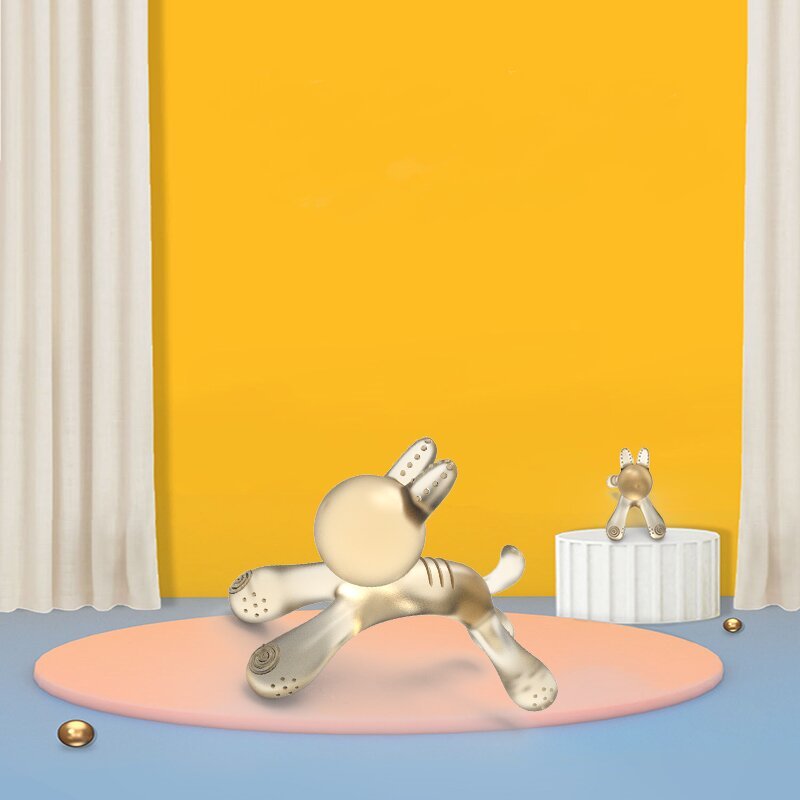
3. The outstretched pose is a stability decision
The rabbit “lying flat with legs forward” pose lowers the center of gravity. When the baby drops it — and babies always drop it — the teether lands without bouncing off the highchair tray. Small detail, but parents notice, and reviews mention it.
From Teether to Feeder: The Same Grip Grows with the Baby
Here is where a single SKU becomes a brand story. At around 6 months, the same baby who chewed the rabbit’s ears starts reaching for food. The hand position barely changes — which is why pairing the rabbit teether with a feeding product in the same silicone family is one of the easiest cross-sells in this category.
Our silicone fruit feeder pouch is built on exactly this logic: the same food-grade silicone, the same easy-grip handles sized for the same hands, but now the baby chews on chilled fruit inside the pouch instead of on the teether’s ears. Retailers who shelve them together routinely see the teether pull the feeder into the basket. If you are building a range rather than buying a single item, read the fruit feeder product page and think of the two products as stage one and stage two of one journey.

How a Silicone Teether Manufacturer Actually Produces This Design
Buyers often ask what happens between approving a rabbit sketch and receiving a container. The short version runs through five gates, each with its own failure mode:
| Stage | What happens | Common failure the gate catches |
|---|---|---|
| 1. Design review (DFM) | Wall thickness, texture depth, and draft angles are checked so the shape can actually be molded | Ears too thin — tear during demolding |
| 2. Tooling | CNC-machined mold, typically 10–15 days for a new teether shape | Parting lines placed across visible textures |
| 3. LSR injection | Platinum-cured liquid silicone injected and heat-cured | Under-cured centers; cloudy finish |
| 4. Post-cure & washing | Secondary cure removes volatiles; deionized washing removes residue | Odor complaints in the first unbox |
| 5. Inspection | Dimensional checks, pull tests on ears and legs, visual sort | Flash residue, off-color batches |
We walk through the full factory process — with photos — in a separate article, inside a silicone teether manufacturer: from design to mass production. And if you want to know what a supplier must prove before you wire a deposit, our teether safety and import checklist covers the certificates and tests to request.
Customizing the Rabbit for Your Brand
The rabbit in the photos is our house design, but most of what we ship is customized. Because the tooling already exists for this shape, the customization ladder is short:
- Custom color only — Pantone-matched silicone, no new tooling, lowest MOQ, fastest sampling.
- Custom color + logo — debossed logo on the belly or packaged in branded retail boxes.
- Modified rabbit — longer ears, a rattle insert in the body, a loop for pacifier clips. Requires a tooling revision.
- Fully original animal — your own character, sculpted and tooled from scratch; this is the standard ODM path described in our OEM & ODM custom teether solutions overview.
Whichever tier you choose, the process ends the same way: you approve a golden sample before mass production, and every carton is checked against it. We explain how that approval works in our golden sample inspection Q&A — it is the single most useful habit for avoiding “the batch looks different from the sample” disputes.
Why This Shape Survives Retail: A Buyer’s Perspective
From the retail side, the rabbit teether carries three arguments that survive a skeptical category manager. First, the design photographs well — the silhouette is clear even in a 60-pixel thumbnail, which matters more every year. Second, the spec is genuinely parent-friendly: boil it, steam it, freeze it, run it through the dishwasher, and nothing changes. Third, the 3–12 month window is long enough to justify the price and short enough to feel like a “stage” product parents buy deliberately. Stack the stage-one teether against the stage-two feeder from the same brand and you have a tidy shelf story: soothe the gums first, then feed the fruit.
Frequently Asked Questions
What silicone is the rabbit teether made of?
100% food-grade, platinum-cured silicone — the same material family used for medical tubing. It contains no BPA, phthalates, or fillers, and it is inert across the -40°C to 200°C range, which is why the teether can be boiled, steamed, frozen, and dishwashed.
Can I order the rabbit teether in my brand’s colors?
Yes. Color is the easiest customization: we match your Pantone reference in the silicone batch. Logo debossing and custom retail packaging are the next steps up; a modified shape needs tooling changes. Our OEM & ODM overview lists MOQ and sampling timelines for each tier.
How do I clean and sterilize the rabbit teether?
Boil it, put it in a steam sterilizer, or run it through the dishwasher — all three are safe because the teether is one-piece silicone with no seams or inserts. There is no hole for water to enter, so it dries completely.
What age is the rabbit teether for?
It is designed for 3–12 months: from the first gum pressure at three months through late teething. From roughly six months, pair it with a feeding product such as our silicone fruit feeder pouch as the baby moves from chewing textures to chewing food.
See the rabbit shape silicone baby teether product page for the full spec sheet, OEM options, and a direct inquiry.